
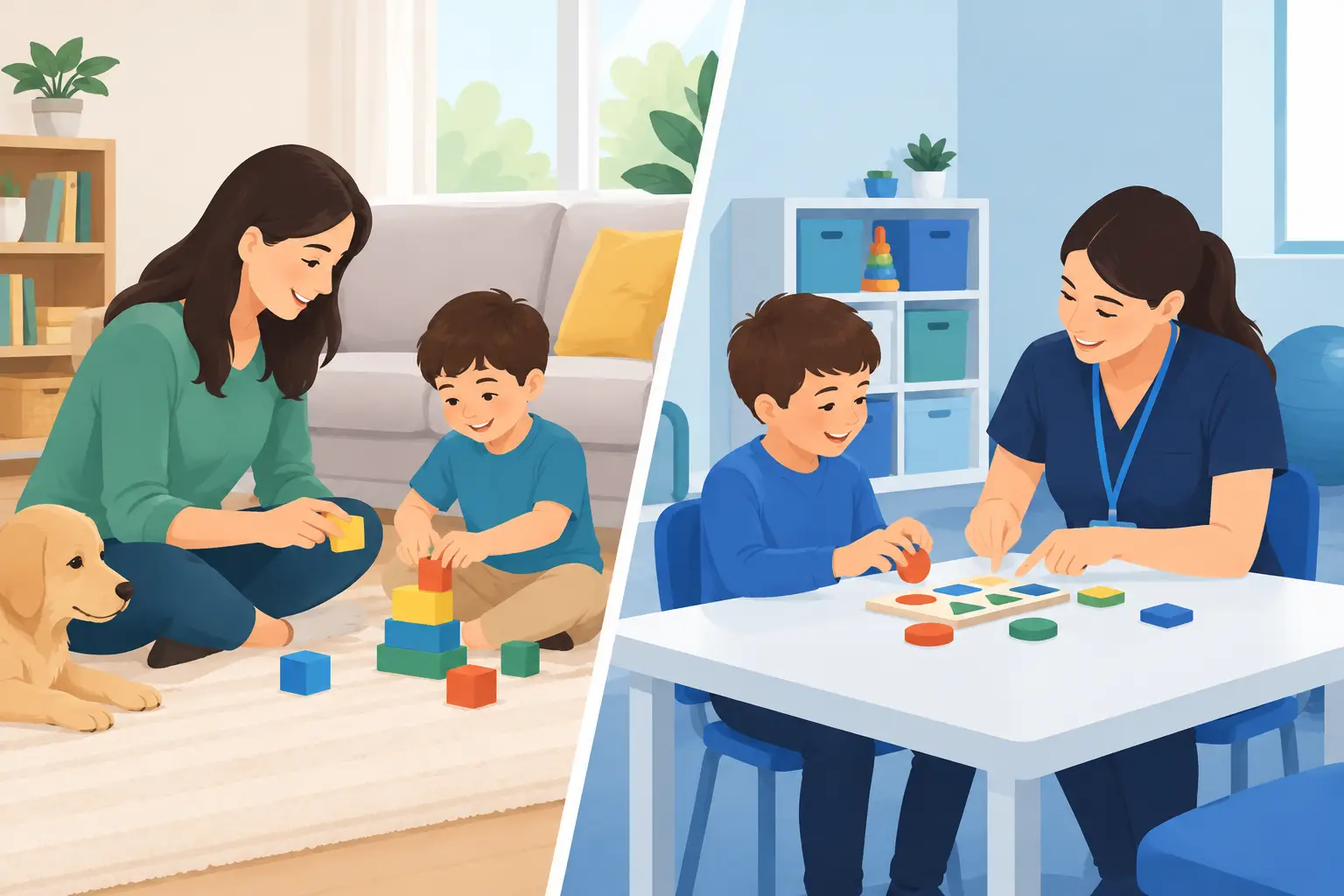

A child may communicate beautifully during a favorite game at home but struggle to join peers at school. Another may be eager to learn in a structured setting yet find morning routines difficult. That is why the question of in-home vs clinic-based aba therapy is not about finding one universally better option. It is about identifying the setting where your child can practice meaningful skills, feel supported, and make steady progress.
Applied Behavior Analysis, or ABA therapy, uses evidence-based teaching strategies to help children build communication, social, daily living, and learning skills. Quality ABA is individualized, positive, and guided by a Board Certified Behavior Analyst (BCBA). The right environment depends on your child’s goals, comfort, needs, family routines, and opportunities to use new skills in everyday life.
What In-Home ABA Therapy Can Offer
In-home ABA therapy takes place where many of life’s most important skills happen: during meals, playtime, getting dressed, bedtime routines, and family conversations. Because therapy occurs in a familiar environment, children can practice skills in the exact situations where those skills are needed.
For example, a therapist may use natural environment teaching, often called NET, to support communication during a preferred activity or help a child participate in putting away toys after play. The teaching is purposeful, but it can feel playful and relevant to the child’s real routines.
Home-based services can also give parents and caregivers more opportunities to observe strategies in action. Parent collaboration is a meaningful part of ABA care. A BCBA may help caregivers understand how to use positive reinforcement, create consistent expectations, and recognize small but important milestones. This is not about asking families to become therapists. It is about giving families practical, supportive tools that fit their lives.
When home may be a strong fit
In-home therapy may be especially helpful when a child’s current goals involve daily routines, communication with family members, or participating more comfortably in familiar settings. It can also be a good option for children who initially find new environments overwhelming or who benefit from learning in a space they already know well.
Convenience matters, too. Families balancing work schedules, school drop-offs, siblings, and appointments may appreciate reducing travel time. Still, being at home does not automatically make therapy easier. Homes can be busy, and distractions such as visitors, pets, screens, or siblings may affect a session. An experienced clinical team plans thoughtfully around those realities rather than expecting family life to be perfectly quiet.
What Clinic-Based ABA Therapy Can Offer
Clinic-based ABA therapy provides a structured, child-centered setting designed for joyful learning. It can offer consistent routines, dedicated learning materials, and planned opportunities to practice communication, play, self-care, and social skills with support.
For many children, the clinic environment creates valuable chances to learn alongside peers. Social development often requires more than learning a skill with an adult. Children may practice waiting for a turn, inviting another child into play, responding to a peer’s idea, or moving through a small-group activity. These experiences can be thoughtfully arranged and supported at a pace that respects each child.
A clinic also allows for close collaboration among trained professionals. Behavior technicians work under BCBA supervision, and the team can coordinate goals, review data, and adjust teaching approaches as a child grows. This level of ongoing oversight helps ensure therapy remains tailored rather than following a one-size-fits-all plan.
When a clinic may be a strong fit
Clinic-based care may be especially beneficial for children who are working on social interaction, school-readiness skills, flexible play, or learning in a setting with more structure and fewer household interruptions. A clinic can also help children practice transitions, following group routines, and building comfort in a community-like environment.
For families in Centennial, Littleton, and nearby South Denver communities, location and scheduling can influence what is realistic. A clinic visit may add travel time, but it may also create a clear, predictable therapy routine separate from home. For some children, that distinction makes it easier to focus and engage.
In-Home vs Clinic-Based ABA Therapy: Key Differences
The biggest difference is not the quality of care. Ethical, evidence-based ABA can be delivered in either setting when it is individualized, compassionate, and supervised appropriately. The difference is where skills are taught and how easily a child can use them across different environments.
In-home therapy often offers immediate relevance. If a child is learning to request help with a snack, participate in getting ready for school, or communicate with siblings, those skills can be practiced where they naturally occur. Clinic-based therapy often offers greater access to structured materials, peers, and carefully planned activities that support broader learning goals.
The most helpful question is not, “Which setting is best?” Instead, ask, “What does my child need to learn next, and where will they have the best opportunity to practice?” A child who needs support with family routines may benefit from time at home. A child ready to develop peer interaction may benefit from clinic sessions. Many children benefit from a combination of settings as their needs and goals change.
How to Choose the Right Setting for Your Child
A thoughtful recommendation should begin with an individualized assessment, not a preset schedule. A BCBA should consider your child’s communication abilities, interests, sensory preferences, safety needs, learning profile, and current challenges. Your family’s routines, transportation, school hours, and caregiver availability also deserve real consideration.
Ask a prospective provider how goals are selected and how progress is measured. Strong ABA programs use ongoing data to see whether teaching strategies are helping. They should be able to explain results in clear, family-friendly language and adjust the plan when progress slows or a goal no longer fits your child’s needs.
It is also reasonable to ask about BCBA involvement. Parents deserve to understand who develops the treatment plan, how often a BCBA observes or reviews services, how technicians are trained, and how caregiver input is incorporated. Therapy should feel collaborative. You know your child deeply, and your observations are valuable clinical information.
Consider whether skills will generalize
Generalization means using a learned skill with different people, places, and materials. It is one of the most meaningful signs that learning is becoming useful in daily life. A child may learn to ask for a turn during a clinic game, then practice the same skill at deKoevend Park or with a sibling at home.
Both home and clinic settings can support generalization when the therapy team plans for it. The goal is not for a child to perform a skill only in one room with one therapist. The goal is for the skill to support greater confidence, independence, connection, and participation in everyday life.
Questions to Ask an ABA Provider
When comparing services, ask whether the provider offers BCBA-supervised care, how parent or caregiver collaboration works, and how the team adapts therapy to your child’s interests and goals. You may also want to discuss appointment times, transportation needs, school coordination, and which insurance plans are accepted.
If your child attends Littleton Public Schools, Cherry Creek School District, or another local program, ask how the provider supports a schedule that protects school participation and family time. A good clinical team will work with you to make services practical, not add unnecessary stress to an already full week.
At AuraCalm ABA Therapy, families can expect a compassionate conversation about what will help their child learn, connect, and grow. Whether therapy happens primarily at home, in a clinic, or across both settings, the focus should remain the same: tailored care, positive relationships, and meaningful milestones that matter to your family.
The best setting is the one that gives your child room to feel safe, experience joyful learning, and carry new skills into the moments that make up daily life.