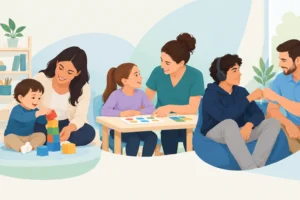

A child does not need spoken words to have meaningful things to say. They may communicate by leading an adult to the pantry, handing over a favorite toy, using facial expressions, pointing, looking toward an item, or becoming frustrated when others do not understand. ABA therapy for nonverbal children can help turn these important attempts into reliable ways to communicate, participate, and connect – while honoring each child’s individual strengths and preferences.
For many families, the most encouraging goal is not simply hearing a child speak. It is seeing their child confidently request help, share enjoyment, make choices, understand what comes next, and feel understood at home, school, and in the community.
What ABA Therapy for Nonverbal Children Focuses On
Applied Behavior Analysis, or ABA, is an evidence-based approach that uses observation, positive reinforcement, and individualized teaching to build meaningful skills. For a child who is nonverbal or uses few spoken words, therapy often begins with communication, but it should never stop there.
A BCBA – a Board Certified Behavior Analyst – evaluates the child’s current skills, interests, everyday routines, and communication attempts. The clinical team then creates a tailored care plan with goals that matter to the child and family. These may include requesting a preferred item, responding to a caregiver, following a simple routine, taking turns in play, tolerating transitions, or building self-help skills such as washing hands or putting on shoes.
The most effective goals are functional. If a child can tell someone “more,” “all done,” “help,” or “I need a break” in a way that works for them, they gain greater access to their world. That can reduce frustration and create more opportunities for joyful learning.
Communication Is Bigger Than Speech
“Nonverbal” is often used when a child does not communicate with spoken language or uses very limited speech. Yet communication can take many forms, and a child’s abilities may change across settings and over time. Some children use gestures, signs, pictures, a communication board, or an augmentative and alternative communication system, often called AAC.
AAC can include low-tech tools, such as picture cards, as well as speech-generating devices or tablet-based communication applications. Using AAC does not prevent speech development. For many children, it gives them a dependable way to express themselves now while spoken-language goals are supported when appropriate.
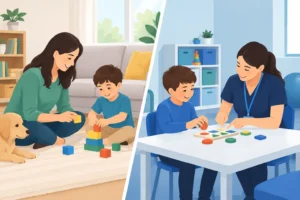
In ABA services, a therapist may teach a child how to use their chosen communication method during real moments of the day. Rather than practicing words only at a table, a child might learn to select “swing” before playing outside, “snack” during a break, or “help” when a toy container is difficult to open. This approach is called natural environment training, or NET. It connects communication to meaningful outcomes the child wants and understands.
How Positive Reinforcement Supports Learning
Positive reinforcement means that a helpful behavior is followed by something the child values, making them more likely to use that skill again. For a young child, the reinforcement might be access to bubbles after requesting them, a turn with a favorite train, praise, or a shared silly game. What feels rewarding differs from child to child, which is why careful observation matters.
This is not about pressuring a child to perform. Ethical ABA is collaborative, responsive, and respectful. Therapists watch for signs of engagement or discomfort, offer choices, adjust demands, and teach skills in small, achievable steps. Learning should feel safe and encouraging.
A therapist may begin by reinforcing any clear communication attempt. Over time, they can help the child use that skill with more people, in more places, and for more purposes. A child who first requests a favorite snack with one therapist may later use the same system with a parent, sibling, teacher, or grandparent.
Skills That Can Grow Alongside Communication
Communication is often the foundation, but a comprehensive ABA plan also supports daily living, social participation, and flexibility. The right priorities depend on the child’s age, needs, and family routines.
For a preschooler, therapy may focus on joining a short play activity, moving between activities with visual support, or communicating a choice at snack time. For a school-age child, goals might include participating in classroom routines, asking for clarification, completing parts of a hygiene routine, or engaging with peers around a shared interest. Teenagers may benefit from support with self-advocacy, community participation, household responsibilities, and practical independence.
Progress is rarely a straight line. A child may use a new skill easily in the clinic but need more practice at home, at deKoevend Park, or in a busy grocery store. That is expected. Generalization – using a skill across people, settings, and materials – is a central part of thoughtful ABA programming.
What Parents Can Expect From a Quality ABA Program
Families deserve clear communication from their child’s care team. Before services begin, a BCBA should complete an assessment and talk with parents or guardians about their concerns, priorities, schedule, and the child’s interests. Therapy goals should be understandable, measurable, and connected to everyday life.
Ongoing data collection helps the team see whether a teaching approach is working. Data should inform decisions, not replace professional judgment or family input. When progress slows, the clinical team can review the goal, consider barriers, and adjust the teaching strategy.
Family participation also matters. Parents do not need to become therapists or add hours of practice to an already full day. A supportive team can show caregivers how to create simple opportunities for communication during meals, bath time, play, getting dressed, or rides to school. Small, repeatable moments often make a meaningful difference.
Collaboration may include other professionals when appropriate, such as speech-language pathologists, occupational therapists, pediatricians, and school teams. ABA providers can support consistent communication strategies while respecting the roles and expertise of the broader care team.
Questions to Ask When Choosing ABA Services
When comparing providers, ask who will supervise your child’s program and how often the BCBA observes and updates it. Ask how communication goals are selected, whether AAC is supported, and how therapists teach skills beyond a therapy room. It is also reasonable to ask how the provider includes parents, coordinates around school schedules, and handles insurance questions.
For Centennial and Littleton families, convenience matters too. A clinic close to home, school, or regular routines can make it easier to maintain consistency. Families in the Southglenn area or near Littleton Public Schools and Cherry Creek School District may also want to discuss appointment times that work alongside school and family life.
At Success On The Spectrum Centennial ABA Therapy, families can expect BCBA-supervised, family-focused care built around meaningful milestones and respectful partnership. The goal is not to make every child communicate in the same way. It is to help each child develop tools that make their voice easier for others to hear.
Every new gesture, picture selection, shared smile, or successful request can represent real growth. With patient, evidence-based support and a team that listens closely, children can build communication and independence in ways that feel personal, practical, and full of possibility.
Every Child Can Thrive. Let’s Start Together.
If you’re ready to help your child build a strong foundation for school and life, we’re ready to help.
 Success On The Spectrum Centennial 7562 S University Blvd, Ste FF, Centennial, CO 80122
 720-372-2659
 centennial@successonthespectrum.com
 successonthespectrum.com/location/Centennial/
Schedule your free consultation today — and let’s give your child the best possible start. 
Serving Centennial, Denver, Aurora, Littleton, Castle Pines, Highlands Ranch, Lone Tree, Englewood, Parker, and surrounding communities.