
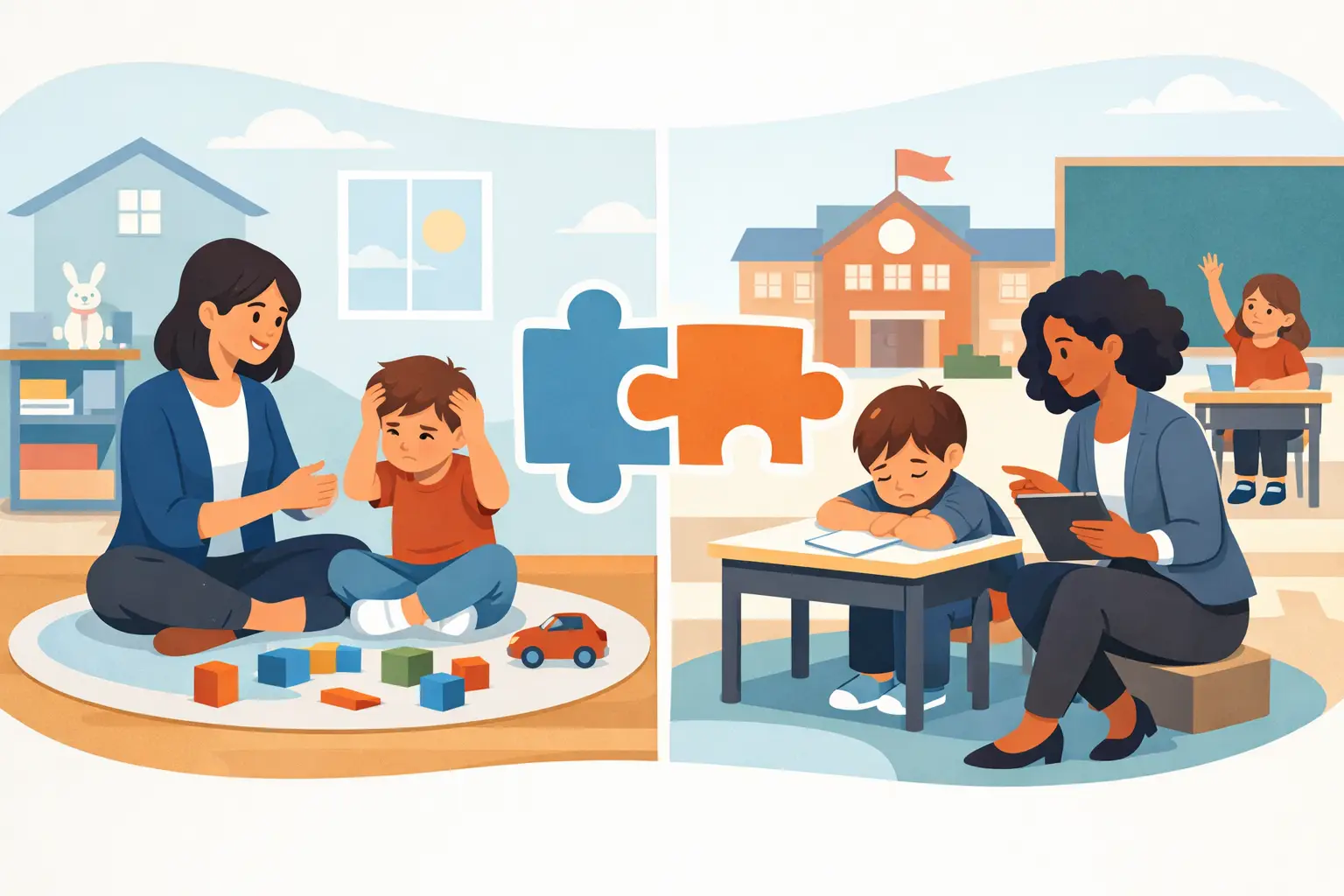

A difficult morning can leave any parent wondering what is typical, what is a passing phase, and when extra support could help. If you have found yourself searching for “signs my child needs aba therapy,” you are not alone. Many families begin looking for answers after noticing that everyday routines, communication, play, or school participation feel harder for their child than they expected.
ABA, or Applied Behavior Analysis, is an evidence-based approach that helps children build meaningful skills through positive teaching, practice, and reinforcement. It is not about changing who a child is. Thoughtful, modern ABA therapy is individualized and family-focused, supporting communication, independence, emotional regulation, and joyful learning in ways that respect each child’s strengths and needs.
Signs My Child Needs ABA Therapy: Patterns Worth Noticing
No single behavior means a child needs ABA therapy, and parents do not need to diagnose their child before asking for help. What matters most is the pattern: whether a challenge happens often, interferes with daily life, limits participation, or causes distress for your child or family.
Communication feels consistently difficult
A child may benefit from an evaluation when it is hard for them to express wants, needs, feelings, or discomfort in a way others understand. This can look different at different ages. A young child may not yet use gestures, words, pictures, or another reliable way to request help. An older child may use language but struggle to answer questions, participate in back-and-forth conversation, or communicate when upset.
When communication is difficult, behavior can become a child’s quickest way to be understood. A BCBA, or Board Certified Behavior Analyst, can assess what a child is communicating and identify supportive ways to teach functional communication. This may include spoken language, visual supports, sign language, or augmentative communication, depending on the child.
Everyday transitions lead to frequent distress
Many children dislike stopping a preferred activity or facing an unfamiliar routine. The concern is not that a child occasionally protests. It is when transitions regularly lead to intense distress, prolonged difficulty, or a disruption that makes home, school, errands, or community outings feel unmanageable.
For example, a child may have a particularly hard time moving from a tablet to dinner, leaving the playground, getting dressed, or adjusting to a substitute teacher. ABA can help by breaking routines into teachable steps and practicing flexible transitions gradually. The goal is not compliance for its own sake. It is helping a child feel more prepared, capable, and secure as plans change.
Daily living skills need more support than expected
Independence grows over time, and every child develops at their own pace. Still, it can be helpful to seek support when routines such as toileting, dressing, brushing teeth, eating meals, sleeping, or following a simple schedule remain consistently difficult and affect family life.
ABA therapy can teach these skills in small, achievable steps. A therapist may use modeling, prompts that fade over time, and positive reinforcement to help a child practice successfully. Progress can be gradual, especially with skills involving sensory preferences or anxiety, but tailored care helps make milestones more reachable without overwhelming the child.
Play and social connection are hard to access
Children connect in many valid ways, and not every child enjoys large groups or pretend play. It may be worth exploring support when your child wants connection but does not know how to enter play, share an activity, take turns, notice social cues, or recover from a peer misunderstanding.
Social goals should be personal, not one-size-fits-all. For one child, a meaningful goal may be playing beside another child comfortably. For another, it may be asking a classmate to join a game or learning how to take a break from a noisy group. Natural environment teaching, often called NET, gives children chances to practice these skills during play and real-life activities rather than only at a table.
Big reactions are limiting participation
Children may cry, yell, run away, shut down, or become overwhelmed when demands, sensory experiences, communication barriers, or unexpected changes pile up. These reactions are not a sign of bad parenting or a child being “difficult.” They are information that something in the moment may be too hard, unclear, uncomfortable, or inaccessible.
A qualified ABA team looks beyond the behavior itself. They work to understand possible triggers and the purpose the behavior serves, then teach safer, more effective skills that meet the same need. If there is an immediate safety concern, contact your child’s medical provider or appropriate emergency support. An individual clinical assessment is necessary before any behavior plan is created.
When Challenges Show Up in More Than One Setting
One useful question is whether the concern occurs only in one situation or across several settings. A child who struggles at school but not at home may need accommodations, a different school-based support approach, or more time to adjust. A child who has similar difficulties at home, with relatives, in childcare, and in the community may benefit from a broader developmental and behavioral assessment.
It also helps to notice what happens before and after a challenge. Is it more likely when your child is tired, hungry, rushed, asked to wait, faced with loud noise, or unable to communicate a need? You do not have to collect perfect data. A few simple observations can help a clinical team understand your family’s routines and begin a more collaborative conversation.
What an ABA Evaluation Can Tell You
An ABA evaluation is not a test your child can pass or fail. It is a structured, compassionate process for learning about strengths, needs, interests, current skills, and barriers to participation. A BCBA typically meets with parents or caregivers, observes the child, reviews relevant history, and may use age-appropriate assessment tools.
You should have room to share what matters most to your family. Perhaps mornings are difficult, your child cannot participate in a Littleton Public Schools classroom routine, or family outings near Southglenn have become stressful. Your priorities should guide the plan. A quality provider explains recommendations in plain language, answers questions honestly, and adjusts goals as your child grows.
ABA is not the right level of support for every concern. Sometimes a family may need a developmental evaluation, speech-language services, occupational therapy, school supports, or a combination of services. A trustworthy clinic will help you understand the options rather than treating every challenge as though it has one answer.
What Support Should Feel Like
Parents often worry that therapy will take over childhood or create another demanding schedule. The right plan depends on your child’s needs, age, school schedule, and family capacity. Some children benefit from focused skill-building sessions, while others need more comprehensive support. Collaboration with caregivers is essential because the most valuable progress carries into daily life.
Look for care that is BCBA-supervised, strengths-based, and grounded in positive reinforcement. Your child should be treated with dignity, offered choices when appropriate, and encouraged through engaging activities. You should know what goals are being taught, why they matter, how progress is measured, and how you can support skills at home without turning every family moment into therapy.
For Centennial, Littleton, and South Denver families, an initial conversation with a local ABA clinic can bring clarity even when you are still sorting through questions about diagnosis, insurance, or scheduling. AuraCalm ABA Therapy provides compassionate, evidence-based support designed around each child and family.
You know your child better than anyone. Trusting your observations does not mean assuming the worst. It means giving your child access to supportive tools, patient teaching, and a team that can help everyday moments feel more possible – one meaningful milestone at a time.
 Schedule Your FREE Facility Tour & Consultation Today
Success On The Spectrum Centennial  Centennial, CO 80122
  Call us at 720-372-2659 to schedule your FREE facility tour and consultation — no obligation
  Visit our website for more information about our programs
  Email us at centennial@successonthespectrum.com — we respond within 24 hours or Book a Facility tour of SOS Centennial online
Enrollment Now Open — No Waitlist Contact SOS Centennial Today
Ready to Get Started?
Success On The Spectrum Centennial ABA Therapy — Centennial, Colorado 720-372-2659 Call us today to schedule your FREE intake consultation Visit our website to learn more about our programs Email us at centennial@successonthespectrum.com with any questions — we respond within 24 hours.
Proudly serving Centennial, Highlands Ranch, Lone Tree, Parker, Aurora, and surrounding communities at 7562 S University Blvd., STE FF, Centennial, CO 80122
Call us today: 720-372-2659
Email us: centennial@successonthespectrum.com
Book a Facility tour of SOS Centennial
Address: 7562 S University Blvd., STE FF, Centennial, CO 80122
Visit our website contact page: https://successonthespectrum.com/location/centennial/ or https://auracalmabatherapy.com/
Facebook – https://www.facebook.com/successonthespectrumcentennial/
Instagram – https://www.instagram.com/soscentennial/